Dolphin Interaction Bali: Why Voluntary Participation Matters in Animal Welfare
For many travelers visiting Indonesia, engaging in a dolphin interaction Bali session is seen as a memorable highlight of their holiday. The opportunity to see marine mammals up close naturally generates excitement and fascination. However, evaluating any wildlife program requires looking beyond visitor gratification or surface-level entertainment. The central consideration must always be the welfare of the animals involved.
A smooth or engaging guest encounter does not automatically indicate that an animal’s long-term biological, physical, and psychological needs are being met. Understanding responsible wildlife tourism requires examining key welfare concepts, such as voluntary participation, positive reinforcement, environmental enrichment, and strict interaction boundaries. This guide explores the principles of marine mammal welfare, offering travelers a critical framework to evaluate animal-visitor interactions responsibly.
What Does Animal Welfare Mean for Dolphins?
Animal welfare refers to the overall quality of life experienced by an individual animal, encompassing its physical health, biological functioning, and mental state. To evaluate welfare comprehensively, scientific and zoological bodies—such as the World Association of Zoos and Aquariums (WAZA) and the European Association of Zoos and Aquaria (EAZA)—rely on the Five Domains Model.
The Five Domains Model provides a structured framework for evaluating animal experience across five interconnected areas:
- Nutrition: Access to fresh, balanced, and species-appropriate food alongside clean water, free from forced competition or deprivation.
- Physical Environment: Enclosure conditions that provide suitable space, shade, water quality, noise control, and physical comfort.
- Physical Health: The absence of disease, injury, physical discomfort, or chronic stress through rigorous veterinary oversight and preventative care.
- Behavioural Interactions: Opportunities to express natural, species-typical behaviors, maintain social group dynamics, and exert agency over their environment.
- Mental State: The cumulative internal experience of the animal, where negative states (such as anxiety, boredom, or frustration) are minimized and positive states (such as comfort, curiosity, and play) are fostered.
Evaluating welfare requires analyzing all five domains continuously over time. A dolphin’s willingness to follow a cue or its physical appearance in a brief public session represents only a single moment and cannot serve as proof of overall welfare.
Why Voluntary Participation Matters
In modern marine mammal management, voluntary participation is a foundational principle of ethical animal care. It describes an approach where animals are given the choice to participate in training sessions, medical checks, or visitor interactions without force, physical restraint, or food deprivation.
Key aspects of voluntary participation include:
- Choice and Environmental Control: Psychological well-being in intelligent mammals is strongly linked to having agency—the ability to make choices that affect their immediate environment, including choosing to opt out of an activity.
- Positive Reinforcement Training (PRT): Animals are taught specific behaviors through positive reinforcement (such as food rewards, tactile praise, or environmental rewards). Correct responses are rewarded, while non-responses or incorrect choices are simply ignored without punishment or food withholding.
- The Option to Opt Out: A genuine voluntary system allows an animal to walk away or swim to an non-interactive zone at any point during a session without negative consequences.
Critical Distinction: Trained Response vs. Ethical Consent
It is vital for visitors to understand that an animal following a trained cue is demonstrating learned behavior, not legal or ethical human-style “consent.” An animal’s participation is shaped by its training history, environment, and available alternatives.
Furthermore, there is a clear distinction between:
- Executing a highly practiced, trained behavior.
- Choosing between two or more offered activities.
- Having the genuine freedom to step away from an interaction entirely.
While positive reinforcement training significantly reduces stress compared to forced restraint, the presence of trained behaviors alone does not prove that an animal has total autonomy during public interactions.
The Trainer’s Responsibility in Animal-Visitor Interactions
In facilities that host public encounters, animal care staff bear the primary responsibility of protecting the animals’ health and emotional boundaries. A trainer’s role extends far beyond guiding guest positions; they must actively advocate for the animal throughout the session.
Continuous Behavioral Monitoring
Trainers must evaluate an individual animal’s physical posture, swimming patterns, and subtle behavioral cues before and during every interaction. Assessment cannot rely merely on whether the animal completes a command. If an animal exhibits signs of fatigue, frustration, or subtle avoidance, staff must prioritize the animal’s state over guest expectations.
Managing Interaction Boundaries
Trainers are responsible for strictly enforcing guest touch boundaries, entry rules, and physical positioning. Allowing visitors to make unauthorized contact, shout, or crowd an animal compromises both safety and welfare.
The Authority to Pause or Stop Sessions
An essential indicator of a responsible welfare policy is whether trainers have explicit operational authority to pause, adjust, or completely cancel an interaction session if an animal shows reluctance, stress, or if environmental conditions deteriorate. Guest satisfaction or prepaid tickets must never override an animal’s immediate well-being.
Interdisciplinary Health Collaboration
Effective welfare management requires ongoing collaboration between trainers, daily animal keepers, and qualified veterinary professionals. Comprehensive care involves regular health audits, bloodwork monitoring, and behavioral tracking recorded over months and years.
Enrichment Is More Than Training or Entertainment
Environmental enrichment involves providing environmental stimuli that encourage animals to use their natural biological, physical, and cognitive capabilities. Enrichment is an essential component of professional animal care, designed to promote psychological well-being and prevent chronic boredom.
Ethical enrichment programs incorporate several distinct modalities:
- Physical Enrichment: Access to varied water depths, currents, underwater structures, or floating objects that encourage physical exercise.
- Cognitive Enrichment: Problem-solving puzzles, novel objects, or cognitive tasks that require mental processing and exploration.
- Social Enrichment: Opportunities to interact naturally with compatible social pod members, form social bonds, or engage in natural group behaviors.
- Environmental Enrichment: Variations in daily schedules, acoustic environments, or habitat features that break up artificial predictability.
It is important to distinguish between behavioral enrichment and public entertainment. An activity that looks exciting or playful to a human spectator—such as a high-jumping leap or a scripted trick—does not automatically fulfill an animal’s cognitive or behavioral enrichment needs. True enrichment is designed specifically for the animal’s benefit, regardless of whether guests find it visually entertaining.

Setting Clear Boundaries for Dolphin Interactions
Responsible wildlife tourism requires establishing strict operational limits on how humans engage with marine mammals. Interaction programs must operate within structured, transparent boundaries:
- Contact Limitations: Physical contact should be strictly regulated, limited to specific non-sensitive body areas, and guided entirely by animal care professionals. Uncontrolled touching or chasing must be strictly prohibited.
- Session Duration and Frequency Caps: Facilities must limit the length and total daily frequency of guest interactions to ensure animals spend the majority of their time in non-interactive, social, or restful states.
- Dedicated Non-Interactive Zones: Habitats should feature sanctuary areas or deeper water zones where animals can retreat away from public view and guest contact whenever they choose.
- Visitor Compliance and Responsibilities: Visitors must follow trainer briefings explicitly, maintain quiet posture, avoid sudden motions, and accept that direct touch or specific poses are never guaranteed.
Interacting with a marine mammal is a privilege governed by animal welfare principles, not an absolute right guaranteed by a ticket purchase.
How Should Visitors Evaluate an Animal Interaction Program?
Travelers seeking to make ethical travel choices can evaluate marine facilities using objective, verifiable criteria. Before booking or participating in a program, consider asking the following questions:
- Does the facility publish clear, transparent animal welfare policies?
- Are interaction sessions actively supervised by qualified animal care professionals?
- Are there strict, enforced limits on physical contact and session durations?
- Do animals have dedicated retreat zones where they can choose not to participate?
- Do staff have the operational authority to cancel or modify a session if an animal opts out?
- Does the facility provide transparent information regarding its veterinary care, enrichment programs, and welfare monitoring?
Prospective guests should rely on verifiable policy disclosures, independent zoological accreditations, and scientific literature rather than promotional videos, glossy marketing, or casual tourist reviews.
Contextualizing Dolphin Interactions in Bali
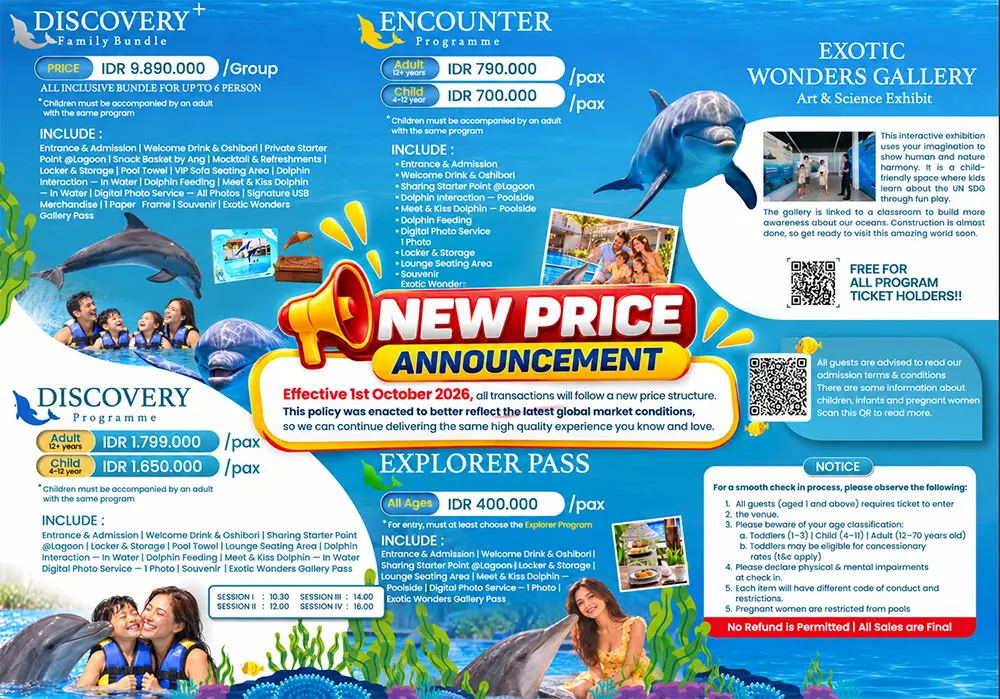
Travelers researching destinations in Indonesia will encounter facilities such as Bali Exotic Marine Park (BEMP) in South Denpasar, which offers commercial interaction tiers like its Discovery and Encounter options.
When evaluating regional marine venues like BEMP, travelers should maintain a clear, objective perspective. While official program descriptions outline the presence of instructor guidance, structured interaction protocols, and basic check-in briefings, visitors should not assume that the existence of a trainer automatically guarantees optimal long-term welfare or full voluntary participation.
Publicly available facility descriptions provide basic details on session structures, but comprehensive data regarding daily enrichment schedules, specific voluntary opt-out protocols, or long-term veterinary audits require direct inquiry. Conscientious travelers are encouraged to ask venue management specific questions regarding their animal care policies and evaluate venue transparency directly before booking.
Conclusion: Making Animal Welfare a Priority in Dolphin Interactions
Evaluating a dolphin interaction Bali experience requires shifting the focus away from human entertainment and placing animal welfare at the center of the discussion. A truly responsible approach recognizes that animal welfare relies on the Five Domains Model, genuine voluntary participation, ethical positive reinforcement training, comprehensive enrichment, and enforced interaction boundaries.
By asking critical questions, seeking transparent information, and prioritizing animal care over photo opportunities, travelers can advocate for higher standards in wildlife tourism.
Traveler Review & Policy Notice
Travelers researching regional venues can read Bali Exotic Marine Park reviews on Tripadvisor to consult independent visitor feedback regarding customer service, facility cleanliness, and check-in procedures. Please note that Tripadvisor currently displays an operational notice stating that Bali Exotic Marine Park does not meet Tripadvisor’s Animal Welfare Policy, and tickets are not bookable through their platform. Conscientious travelers should evaluate user reviews alongside official venue disclosures and independent welfare standards when deciding whether to visit commercial wildlife attractions.
To explore official venue details and program rules, visit Bali Exotic Marine Park directly.
Frequently Asked Questions (FAQ)
1. What Is Voluntary Participation in Dolphin Training?
Voluntary participation means that animals are trained using positive reinforcement to participate in daily health checks, physical exercise, or interaction sessions by choice, with the freedom to opt out without punishment or food deprivation.
2. Can Dolphins Choose Not to Participate in an Interaction?
In well-managed welfare frameworks, animals are provided with retreat zones or options to swim away from an interaction session if they choose not to participate. Visitors should verify whether a facility maintains active opt-out protocols.
3. How Does Positive Reinforcement Support Animal Training?
Positive reinforcement rewards desired behaviors with food, tactile praise, or play, while ignoring incorrect responses. This builds trust between animals and care staff while eliminating the need for physical restraint or punishment.
4. What Is Environmental Enrichment for Dolphins?
Environmental enrichment involves providing physical objects, cognitive problem-solving tasks, varied social opportunities, and habitat variations that stimulate an animal’s mind and encourage natural behaviors.
5. Why Should Trainers Be Able to Stop an Interaction Session?
Trainers must have the authority to stop a session if an animal shows signs of fatigue, stress, or reluctance, ensuring that animal health and safety always take precedence over guest expectations or commercial schedules.
6. Does a Dolphin Following Trainer Instructions Mean It Is Comfortable?
Not necessarily. Following a trained cue demonstrates learned conditioning, but it does not provide a complete picture of an animal’s internal mental state or overall welfare, which requires long-term biological and behavioral tracking.
7. What Should Visitors Look for in a Responsible Dolphin Interaction Program?
Visitors should look for transparent welfare policies, strict contact limits, voluntary participation options, dedicated retreat zones, qualified professional supervision, and verifiable veterinary care standards.